Curriculum
Educational concept
Discovering the world through curiosity
Children are curious from birth. They want to explore, try things out, understand and make sense of their world using all their senses. At Kleinen Riesen, we create the conditions that allow children to follow this natural urge to explore and discover, and to develop into self-confident, curious and happy individuals.
Our educational approach is tailored to the individual interests, abilities and needs of each child. We do not view learning as something that takes place solely within structured activities. Children learn every day – through play, observation, asking questions, building, moving, experimenting and interacting with one another.
A particular focus of our educational approach is on early STEM education.
Learning environment
STEM – Research, discover and understanding
STEM stands for Science, Technology, Engineering and Mathematics. Children encounter these four areas quite naturally in their everyday lives.
Why does something fall to the ground? Why does one object float whilst another does not? How is a shadow formed? How high can I build a tower before it falls over? Children grapple with questions like these every day. They observe natural phenomena, compare sizes and quantities, build, sort, count and discover their first technical concepts. This is precisely where our STEM teaching approach comes in.
We take up the children’s questions and encourage them to seek answers for themselves. The aim is not simply to impart ready-made knowledge. It is far more important to us that children observe, experiment, form hypotheses, find solutions and gain their own experiences. In this way, their natural joy in learning is preserved.
Digital media are also part of children’s everyday lives. That is why we support them, in an age-appropriate manner, as they gain their first experiences with digital and technical concepts.
STEM is everywhere
STEM education doesn’t require a laboratory or complicated technology. Many valuable learning experiences arise right in the midst of everyday life at nursery.
- Through building and constructing, for example, children discover what stability means and why some structures stay standing whilst others fall over.
- By sorting, counting and comparing, they gain their first experiences of maths and develop an understanding of quantities, sizes, shapes and structures.
- By experimenting with water, light, magnets or different materials, they learn about scientific principles.
- In role-play, such as playing at the shop, they encounter numbers, quantities and basic mathematical concepts quite naturally.
- And outdoors, children discover plants, animals, the weather and other natural phenomena using all their senses.
A learning environment that sparks curiosity
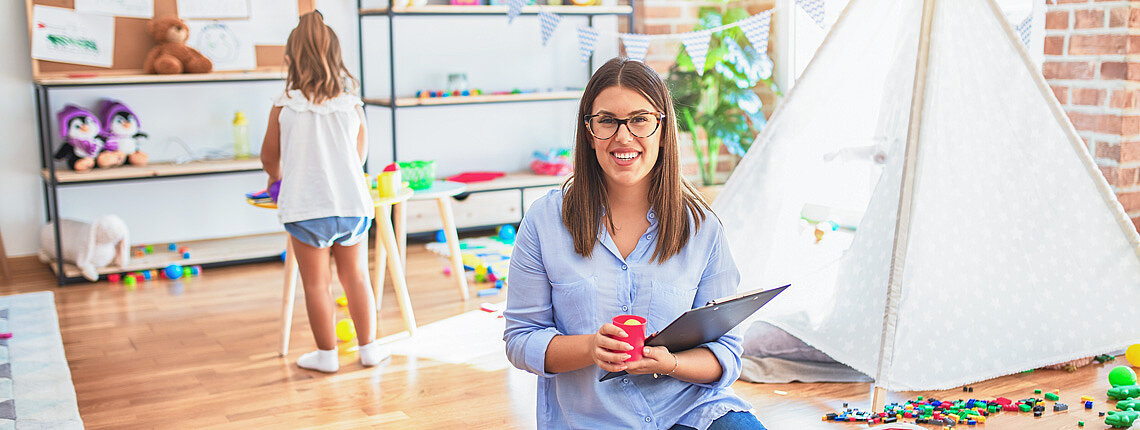
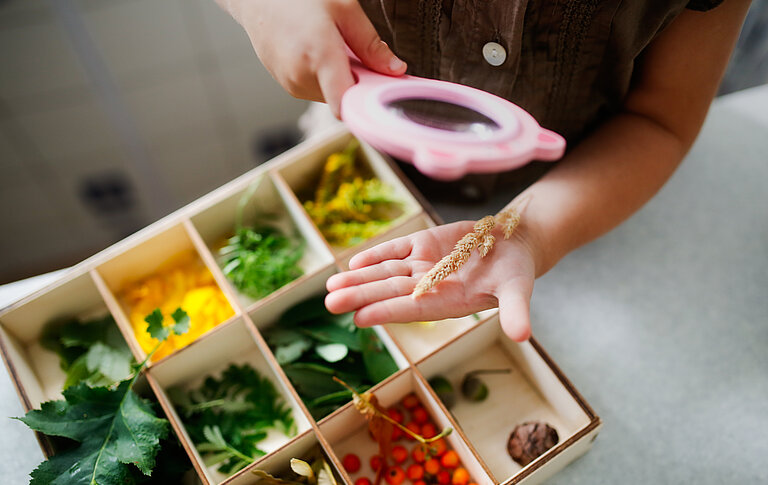
Children learn particularly effectively when their environment encourages them to explore. That is why we design our rooms so that children can be active independently and pursue their own interests. A variety of play, building, creative and exploration areas constantly offer new stimuli. Themed materials, exploration boxes, tubs and activity trays encourage children to try things out and experiment. In doing so, we deliberately make use of simple, everyday materials. Our qualified early years staff closely observe which topics the children are engaged with. They ask questions, provide ideas and create new challenges without dictating solutions to the children. In this way, children realise: ‘I can figure things out for myself.’
Learning with enjoyment and self-confidence
Children possess a natural sense of enthusiasm and a strong desire to learn. Our aim is to preserve and nurture this joy of discovery. In doing so, children do not merely acquire knowledge. They learn to ask questions, develop their own ideas, solve problems and persevere even when they do not succeed at the first attempt. These experiences build self-confidence, creativity and independent thinking – important skills for their future development and educational journey. This is also how we view preparation for school: not as an early start to academic learning, but as a holistic development of the skills children need for their future.

Educational professionals as learning facilitators
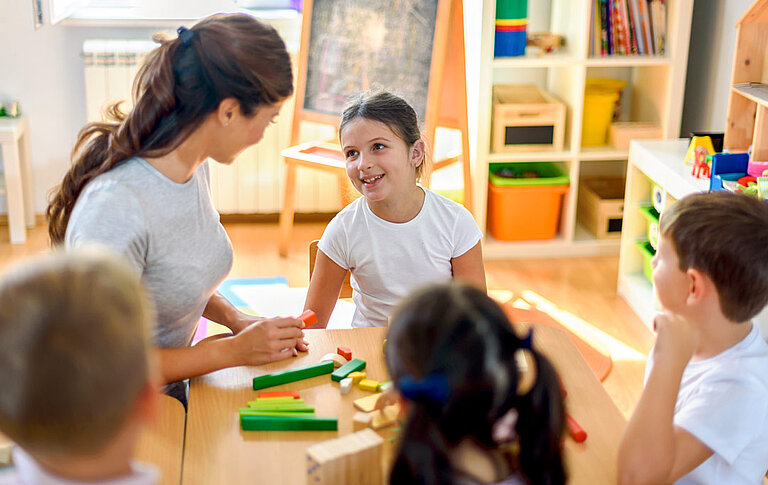
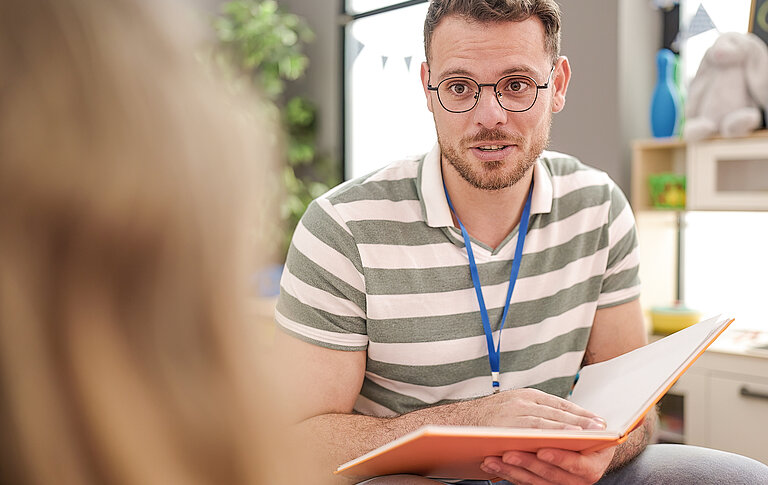
Our educational staff see themselves as facilitators of children’s development. They observe the children’s interests and needs, respond to their questions and create situations in which new experiences become possible. They provide inspiration, ask probing questions and support the children precisely where they need a helping hand. The focus is not on the correct answer, but on the journey towards it: “Why do you think that’s happening?”, “How could we find that out?”, “What else could we try?”. In this way, children experience learning as an active process and realise that their ideas and thoughts matter.
Parents are our partners
A trusting partnership with families is an essential part of our educational work. Parents know their child best. That is why we regard them as important partners and incorporate their observations, experiences and perspectives into our educational work. Through regular dialogue, we discuss the child’s development, their interests, learning experiences and current issues. This fosters a collaborative approach in which the family and the nursery share the same goal: to ensure the child’s best possible development.

Making development visible
Children have new experiences and make developmental progress every day. Our qualified early years staff continuously observe and document these. In doing so, we record significant learning experiences, interests and developmental milestones, and make them visible to children and parents. Portfolios and developmental records provide an insight into each child’s individual learning journey and form a valuable basis for regular development meetings with parents. This enables us to recognise together what a child has already discovered and learnt – and what the next developmental steps will be as a result.
In short
A good STEM education doesn’t have to be complicated – above all, it requires curiosity, creativity and the freedom to experiment.
At Die Kleinen Riesen, we combine a sense of security, personalised support and play-based learning with a strong focus on STEM.
We want to encourage children to stay curious, ask questions and discover their world for themselves.
After all, a simple ‘Why?’ can lead to a great discovery.